Door Repair and Replacement: What to Choose
A sticking front door in July, a drafty patio door in January, or a commercial entry that no longer closes cleanly – these problems rarely stay small for long. Door repair and replacement is often less about reacting to one visible issue and more about protecting security, energy performance, appearance, and daily function. The right answer is not always a full replacement, and it is not always a simple repair either.
For homeowners and property managers, the challenge is knowing what makes sense before spending money. A worn hinge, failed weatherstripping, cracked glass insert, damaged jamb, or swollen wood slab can all look like “the door is bad” when the real problem may be limited to a few components. On the other hand, repeated patchwork on a failing system can cost more over time than replacing it properly once.
How to evaluate door repair and replacement
A good evaluation starts with how the door performs, not just how it looks. If the door drags, rattles, lets in air, shows water damage, has loose hardware, or no longer latches securely, those are signs the assembly needs attention. The next step is figuring out whether the issue is isolated to replaceable parts or whether the door slab, frame, threshold, and surrounding structure have all started to fail together.
Age matters, but condition matters more. An older wood door may still be worth restoring if the core is solid and the character of the home is worth preserving. A newer fiberglass or steel door may need replacement sooner than expected if it was installed poorly, exposed to chronic water intrusion, or paired with substandard hardware. That is why experienced field inspection is so valuable. The details tell the story.
In most cases, repair makes sense when the problem is specific and the rest of the unit is sound. Replacement becomes the better option when multiple parts are failing, the door no longer performs efficiently or securely, or the cost of fixing several issues starts approaching the cost of installing a new unit.
When door repair is the smarter investment
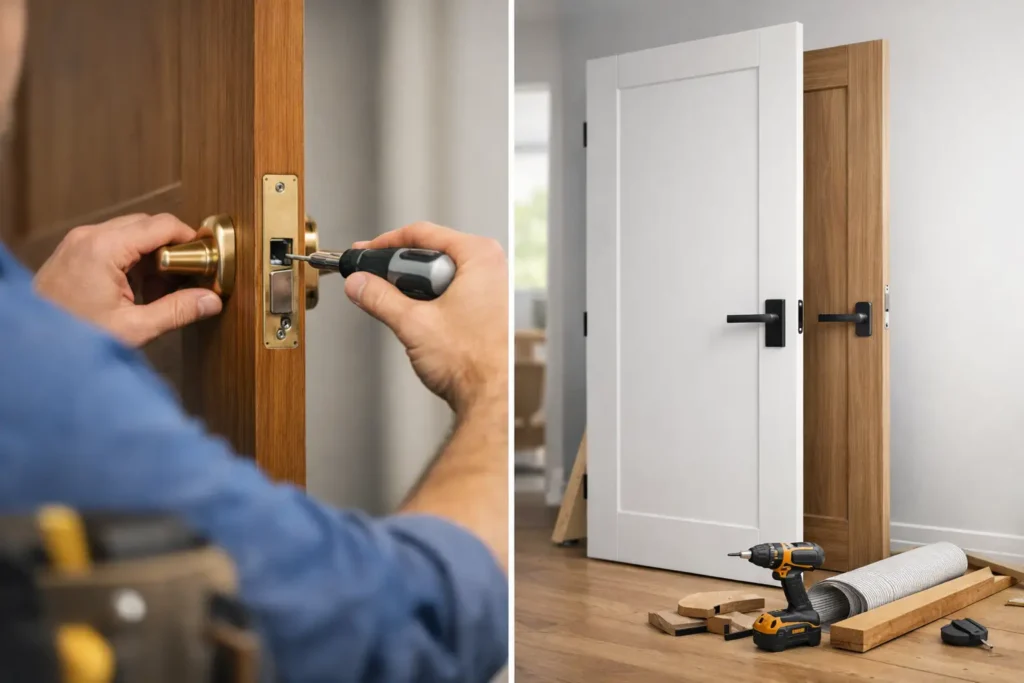
Many door problems can be corrected without tearing everything out. Misalignment is a common example. Sometimes the fix is as straightforward as adjusting hinges, replacing worn screws with longer fasteners, correcting strike plate placement, or planing a wood edge that has swollen with moisture. These are not cosmetic tweaks. They directly affect security, weather resistance, and the lifespan of the door.
Hardware issues are another strong case for repair. Locks, handles, closers, rollers, pivots, thresholds, sweeps, and weatherstripping all wear out before the full door system does. Replacing those parts can restore function quickly and with far less disruption than a full replacement. For commercial properties especially, this can keep doors code-conscious, usable, and professional-looking without interrupting business any more than necessary.
Glass is its own category. If the frame and door are in good shape, a broken pane or failed insulated glass unit does not always mean the entire door has to go. The same is true for certain decorative inserts and sidelights. Precision matters here, because the door still needs to seal correctly, operate smoothly, and maintain its structural integrity after the glass work is completed.
Repair is also the right path when preserving original materials matters. On older homes, a solid wood entry door may have craftsmanship and proportions that are difficult to match with off-the-shelf products. In those cases, skilled restoration and component replacement can protect both curb appeal and long-term value.
When door replacement is the better long-term fix
There is a point where repair stops being practical. If a door is warped beyond adjustment, the frame is rotted, the threshold has failed, and water has already affected the surrounding structure, replacement is usually the cleaner and more cost-effective path. Trying to save a system in that condition often turns into repeated service calls and mounting labor costs.
Security is another reason to replace. If the slab is cracked, the frame is compromised, or the lock area has been weakened by years of stress or forced entry damage, repairs may not restore the strength you need. A properly installed new door with modern hardware and a sound frame offers more confidence than patching a weak point over and over.
Energy performance can tip the decision too. Older doors with poor seals, outdated cores, or single-pane glass can contribute to drafts and temperature swings. Replacing them with a better-insulated unit can improve comfort right away. The savings on utilities alone may not always justify replacement, but when comfort, appearance, and reliability are all part of the equation, replacement often makes more sense.
Then there is design. If the goal is to update the front entry, improve natural light, widen access, or better match a renovation, replacement provides options that repair cannot. New configurations, updated materials, and better hardware can change both function and appearance in a meaningful way.
The real cost question in door repair and replacement
Most customers start with price, which is understandable. But the lowest immediate cost is not always the lowest total cost. A modest repair that adds years of useful life is excellent value. A modest repair that only postpones a replacement by a few months is not.
This is where a repair-first company offers a practical advantage. You want an honest assessment of what can be fixed, what should be fixed, and what is no longer worth investing in. If the frame is solid and the issue is isolated, repair can preserve the door you already have and minimize construction mess. If the system is failing as a whole, replacement may prevent recurring labor charges and additional interior or exterior damage.
Budget flexibility matters too. Some clients need the most economical safe fix now, with a plan to replace later. Others want to solve the problem once and not think about it again for years. Both are reasonable. The best recommendation depends on timing, property goals, and how heavily the door is used.
Why installation quality matters as much as the product
A good door installed poorly will still perform badly. That is true for front doors, patio doors, interior specialty doors, and commercial entries. Alignment, shimming, anchoring, flashing, sealing, threshold setup, and hardware adjustment all affect how the system works after day one.
Many of the problems people blame on a “bad door” actually come from poor installation. Uneven reveals, latch issues, water intrusion, premature hardware wear, and air leaks often trace back to shortcuts during setup. Craftsmanship is not a bonus in this kind of work. It is the reason the repair or replacement holds up.
That is especially important in Georgia, where heat, humidity, rain, and seasonal movement can expose weak workmanship quickly. Materials expand and contract. Sun exposure takes a toll. Moisture finds gaps. Precision at installation helps the door stay dependable under those conditions.
Residential and commercial needs are not always the same
For homeowners, door concerns often center on security, curb appeal, comfort, and preserving finishes that fit the house. For builders, contractors, and commercial property managers, durability, code considerations, hardware performance, scheduling, and repeatable quality may carry more weight. The right service partner should be able to handle both perspectives without oversimplifying the work.
A retail storefront door that sticks every morning presents a different kind of urgency than a decorative entry door with peeling finish, but both require experienced diagnosis. One affects business operations and customer access. The other affects home value, weather protection, and daily convenience. In each case, the answer comes from understanding the full assembly, not just treating the symptom.
Atlanta Window, Door & Glass works in that practical middle ground where repair, restoration, parts service, and full replacement all have a place. That range matters because it gives customers options based on what the door actually needs.
Choosing the right partner for door repair and replacement
The best results come from working with a company that is comfortable recommending repair when repair is the right call and replacement when replacement is the right call. That sounds simple, but it is not always common. Some contractors only want full installs. Others take on repairs without the product knowledge or carpentry skill to address root causes.
Look for experience with frames, hardware, glass, weatherproofing, and finish details – not just swapping slabs. Ask whether the problem is isolated or systemic. Ask what repair will realistically accomplish and how long it is expected to last. Ask what hidden conditions could affect scope once the work begins. Clear answers usually signal real expertise.
A well-executed door project should leave you with more than a better-looking opening. It should close cleanly, seal properly, operate smoothly, and feel solid every time you use it. Whether that comes from a targeted repair or a full replacement depends on the condition of the door, the needs of the property, and the standard of workmanship behind the job.
If your door is giving you trouble, the smartest next step is not guessing. It is getting a precise assessment from someone who knows how to repair what can be saved and replace what should not be stretched any further.